NPS Calculator
Enter how many people gave each score from 0 to 10 and get your Net Promoter Score
Respondents
Enter the number of respondents for each score from 0 to 10
Segments
Calculated totals for each segment
NPS Score
Your calculated Net Promoter Score
What is Net Promoter Score?
Net Promoter Score (NPS) measures customer loyalty with one simple question:
How likely are you to recommend our product to a friend or colleague?
Customers answer on a scale from 0 (not at all likely) to 10 (extremely likely). NPS is easy to track over time and simple to explain across teams. It shows how loyal your customers are, how that changes, and which group of customers to focus on first.
The NPS formula
Subtract the percentage of detractors (scores 0 to 6) from the percentage of promoters (scores 9 and 10).
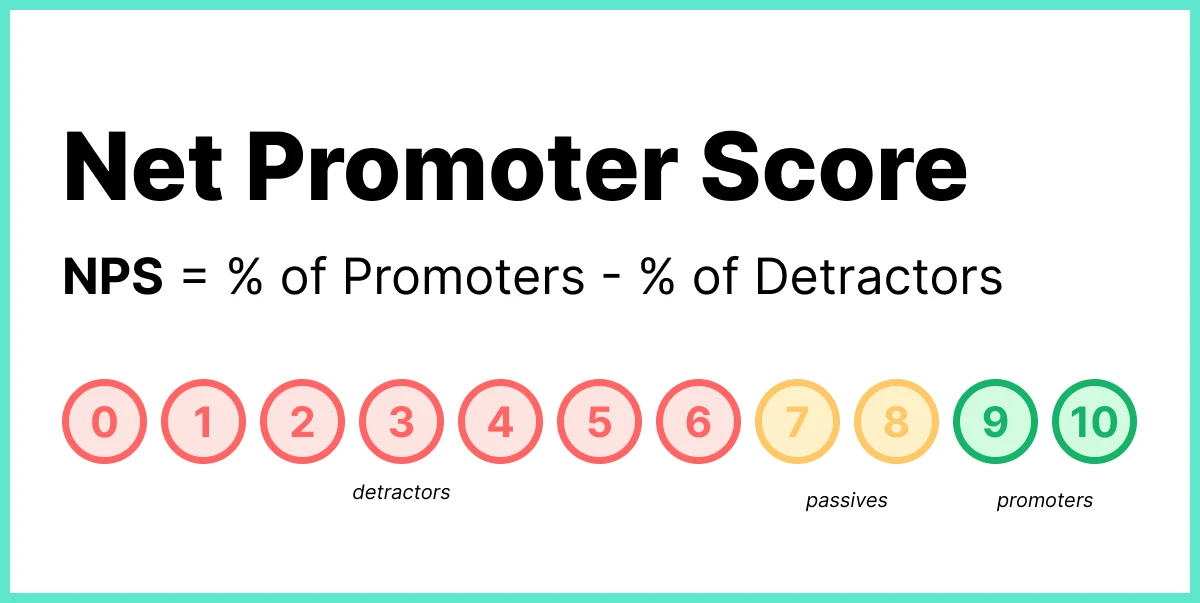
Passives (scores 7 and 8) are not part of the formula, but they count in the total number of responses. The final score ranges from -100 to +100. The what is NPS guide walks through an example step by step.
What does your NPS score mean?
A score of 30 can be strong in one market and average in another, so read the scale as a starting point and compare against your own previous results.
| NPS | Rating | What it means |
|---|---|---|
70 to 100 | Excellent | World-class customer loyalty |
50 to 69 | Great | Strong performance, customers are very satisfied |
30 to 49 | Good | Above average, with room for improvement |
10 to 29 | Needs Improvement | Below average, significant issues to address |
0 to 9 | Poor | About as many detractors as promoters |
Below 0 | Critical | More detractors than promoters, act now |
Prefer a spreadsheet? The NPS Excel template does the same calculation in Excel or Google Sheets.
FAQ
Is this NPS calculator free?
Yes. The calculator, the Excel template and the what is NPS guide are free to use, download and share with your team. No signup or email is required.
What is a good NPS score?
Any positive score means you have more promoters than detractors. A score of 30 to 49 is good, 50 to 69 is great, and 70 or more is excellent. The best comparison is your own previous score, collected the same way. See what a good NPS score is for how to read published benchmarks.
How often should I measure NPS?
For most businesses, once a quarter is enough to see trends without tiring customers with surveys. High-frequency service businesses can measure monthly, and B2B companies with long sales cycles can measure twice a year.
Can NPS be negative?
Yes. NPS ranges from -100, when every customer is a detractor, to +100, when every customer is a promoter. A negative score means you have more detractors than promoters, a clear signal to work on the customer experience first.
Why aren't passives included in the NPS calculation?
Passives (scores 7 and 8) are neutral: they neither promote nor criticize you. They still count in the total number of responses, so more passives lower both percentages. Track them closely, because they are the most likely to switch to a competitor.
Is NPS a percentage?
No. NPS is a whole number from -100 to +100. It is the percentage of promoters minus the percentage of detractors, so percentages power the calculation, but the result is not a percentage.
How many responses do I need for an accurate NPS?
At least 30 to 50 responses give a meaningful score, and more is always better. For a large customer base, make sure the people who answer represent all your customer types.
What is the difference between NPS and CSAT?
CSAT measures satisfaction with a specific interaction or product, usually on a 1 to 5 scale. NPS measures overall loyalty: how likely a customer is to recommend you. NPS is better at predicting long-term business results.
How do I increase the response rate of NPS surveys?
Keep the survey short, send it at the right moment, for example right after a positive experience, explain how you will use the feedback, and close the loop by telling customers what changed because of their answers. An in-app NPS survey reaches people while they use your product.
Should I survey all customers or a sample?
With fewer than 1,000 customers, survey everyone. With more, a representative sample works well. Sample each customer segment separately so you hear from every type of customer.